

Winter Challenges for the Seashore of the Curonian Spit
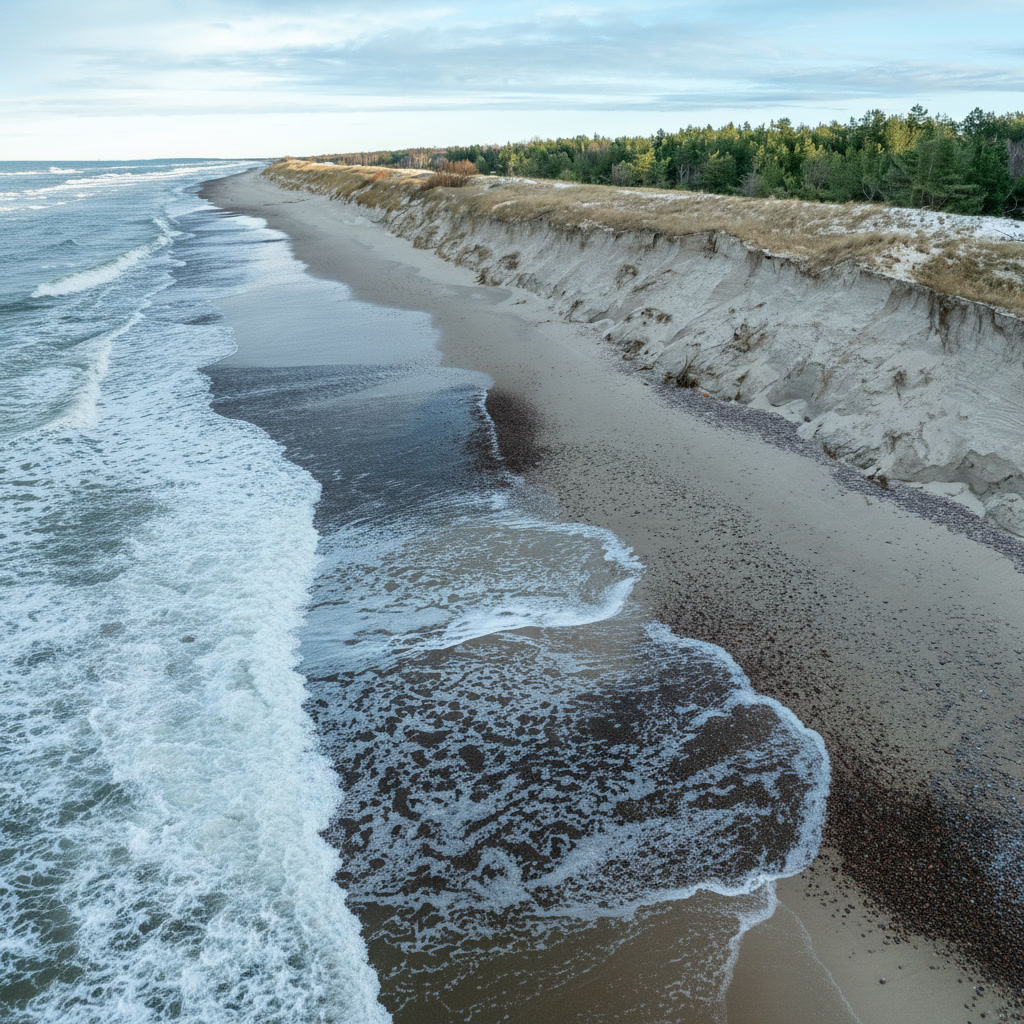
The Curonian Spit National Park Administration is sharing the latest review prepared by scientists from the Nature Research Centre of the State Research Institute, on the meteorological conditions of the 2025-2026 cold season, their impact on the Curonian Spit's coastline, and long-term coastal change trends.
The 2025-2026 winter season was characterized by highly contrasting weather conditions. During autumn and early winter, intensified coastal erosion was recorded due to active cyclonic activity. In some locations, significant changes were caused by strong north - northwesterly winds, with gusts reaching up to 31 m/s. Although the sea level did not reach a critical threshold, considerable sand losses were recorded along several sections of the Curonian Spit's coastline.
From the beginning of January 2026, anticyclonic conditions became dominant. Easterly winds prevailed, the sea level dropped, beaches were covered by a 20-30 cm layer of snow, and a band of shore ice formed along the coastline. These conditions temporarily stabilized the coast. Measurements showed that the sand washed away between October and December 2025 did not return to the shore everywhere, nor did it return completely. On average, after the shoreline retreated by about 5 meters along the Curonian Spit, approximately 87,900 cubic meters of sand were lost (equivalent to -1.73 m³ per meter of coastline).
Long-term data (2002-2026) indicate that the Curonian Spit's Baltic Sea coastline gains an average of 124,300 cubic meters of sand per year. Therefore, the processes observed during the 2025-2026 cold season are not considered exceptional in the context of long-term coastal dynamics. Different years are characterized by periods of both significant erosion and intensive sand accumulation.
The study results show that coastal changes along the Curonian Spit are highly uneven. The most stable section remained the coastline between Smiltynė and Juodkrantė, where the sand balance was positive in many places and the eroded coast recovered relatively quickly. South of Juodkrantė, coastal changes were much more irregular, with heavily eroded sections alternating with areas of sand accumulation. The greatest coastal erosion was recorded north of Nida, approximately 1.5 km north of the town's northern edge.
The scientists emphasize that short-term coastal changes should not be assessed separately from long-term trends (see Figure 1). Over the course of several decades, the Curonian Spit's coastal system has remained dynamic while maintaining an overall The scientists emphasize that short-term coastal changes should not be assessed separately from long-term trends (see Figure 1). Over the course of several decades, the Curonian Spit's coastal system has remained dynamic while maintaining an overall balance between erosion and sand accumulation. Areas experiencing intensive erosion during one period may undergo natural coastal recovery over time.

Figure 1. Changes in sand volume from spring 2025 to spring 2026 (red bars) and the long-term trend in sand volume change during the 2002–2026 period (blue line).
It was also found that different sections of Nida beach are undergoing different coastal processes. In the northern part of Nida, the beach has stabilized in recent years; however, the condition of the foredune is still being maintained through protective measures. In contrast, the central part of Nida is experiencing more intensive foredune growth, which in some areas is occurring naturally without human intervention.
Last updated: 14-07-2026
Related news:
The symbol of the Curonian Spit forests is the European moose (Alces alces).
What Does the Administration of the Curonian Spit National Park Do?